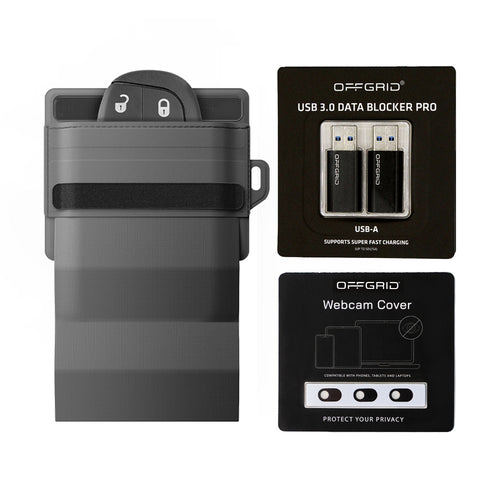

Faraday bags are powerful privacy tools, but they are not magic.
When used correctly, a Faraday bag creates a shielded environment around an electronic device, helping prevent wireless signals from reaching it or leaving it.
That makes Faraday shielding useful for smartphones, tablets, key fobs, radios, and other connected devices when wireless isolation matters.
But putting your phone inside a Faraday bag does not erase your digital footprint, remove malware, secure your passwords, or undo information that has already left the device.
Understanding that distinction is important.
The best privacy strategy is not relying on one tool to solve every problem. It is knowing exactly what each tool protects against and where its protection ends.
What a Faraday Bag Actually Does
A Faraday bag is designed to isolate electronic devices from radio-frequency communication.
Depending on the device and frequencies involved, this can include cellular, Wi-Fi, Bluetooth, GPS-related signals, RFID, NFC, and other radio-frequency communications.
Once a properly shielded device is inside the bag and the bag is completely closed, the goal is simple:
Disconnect the device from the wireless world around it.
That can be valuable for personal privacy, travel, digital forensics, evidence handling, executive protection, vehicle security, and other situations where preventing wireless communication is important.
The key word, however, is wireless.
A Faraday bag addresses a particular layer of security. Other threats require other defenses.
A Faraday Bag Can’t Protect Data You’ve Already Shared
Suppose you use your phone normally throughout the day.
You browse websites, send messages, use apps, upload photos, make purchases, and connect to online accounts.
Later, you place the phone inside a Faraday bag.
The bag can isolate the phone going forward, but it cannot retrieve information that was already transmitted.
Data stored by websites, cloud platforms, mobile applications, advertising networks, or other third parties remains outside the device.
Think of Faraday shielding as closing a door.
It can stop communication across that doorway while it is closed. It cannot pull back everything that went through the door earlier.
It Can’t Remove Malware From Your Device
Wireless isolation and cybersecurity are related, but they are not the same thing.
If spyware, malicious software, or another compromised application is already installed on a phone or laptop, putting that device inside a Faraday bag does not remove it.
The isolation may temporarily prevent software on the device from communicating wirelessly with an outside server. But the underlying compromise can remain.
Once the device leaves the shielded environment and reconnects, malicious software may regain the ability to communicate.
That means suspected device compromise requires an appropriate cybersecurity or forensic response.
Faraday shielding can be useful for isolation, but it should not be confused with remediation.
It Can’t Fix Weak Passwords
Your phone may be completely isolated from cellular, Wi-Fi, and Bluetooth signals while inside a Faraday bag.
Your password can still be password123.
Faraday shielding does nothing to strengthen passwords, secure reused credentials, protect an account from credential stuffing, or prevent someone from signing into an online account using credentials obtained elsewhere.
Account security still requires strong, unique passwords and appropriate authentication practices.
Physical signal isolation and account security solve different problems.
It Can’t Stop Phishing or Social Engineering
Some of the most successful cyberattacks do not require sophisticated wireless technology.
They require a convincing message.
An attacker might impersonate a bank, employer, delivery company, colleague, or government agency and persuade someone to reveal sensitive information.
A Faraday bag cannot determine whether an email is legitimate.
It cannot stop someone from entering credentials into a fake website, and it cannot prevent someone from voluntarily giving sensitive information to an attacker.
Human judgment remains an important part of cybersecurity.
It Can’t Erase Your Location History
This distinction is particularly important.
Putting a phone inside a Faraday bag can prevent wireless communication while the device is properly shielded.
But it does not automatically erase historical information that already exists.
Location information may already have been recorded by apps, online accounts, cloud services, photos, maps, navigation services, or other systems.
Faraday shielding can help prevent new wireless communication during the period of isolation.
It does not rewrite the past.
It Can’t Protect Accounts That Exist Somewhere Else
Imagine your smartphone is securely inside a Faraday bag.
Someone attempts to access your email account from a computer thousands of miles away.
The shielding around your phone does not create shielding around your online identity.
Email accounts, social platforms, financial accounts, cloud storage, and other services exist on remote infrastructure.
Protecting the physical device is only one part of protecting those accounts.
This is why digital privacy has multiple layers. Device security, account security, network security, physical security, and personal behavior all matter.
It Can’t Protect a Device That Isn’t Properly Enclosed
Faraday shielding depends on the integrity of the shielded environment.
If a Faraday bag is not properly closed, the shielding system may not perform as intended.
The same principle applies if shielding materials become damaged or significantly worn.
This is especially important in professional environments where wireless isolation is part of evidence handling, investigations, or operational procedures.
Simply owning a Faraday bag is not enough.
Correct use matters.
It Can’t Make You Anonymous
Privacy and anonymity are not interchangeable.
Using a Faraday bag can reduce a device's ability to communicate wirelessly while shielded, but that does not automatically make the person carrying it anonymous.
Accounts, transactions, surveillance systems, other connected devices, and information previously shared online can all potentially connect activity with an individual.
A Faraday bag is therefore better understood as a device-isolation tool, not an invisibility cloak.
It Can’t Replace Good Digital Security Habits
The strongest privacy strategies use layers.
Faraday shielding provides a physical layer of wireless isolation.
Strong passwords protect accounts. Software updates address known vulnerabilities. Multi-factor authentication adds another barrier to unauthorized access. Careful app permissions can reduce unnecessary data collection. Encryption can help protect sensitive information.
Each layer serves a different purpose.
None of those measures replaces Faraday shielding, and Faraday shielding does not replace them.
Where Faraday Bags Fit Into a Privacy Strategy
There is a tendency in cybersecurity to search for a single product or setting that makes a device “secure.”
That is not how security works.
A Faraday bag has a specific job:
Creating a physical barrier against wireless communication with a shielded device.
That capability can be extremely valuable when you need it.
You might want to isolate a smartphone during a sensitive meeting.
An investigator may need to prevent a seized device from receiving remote commands.
A traveler may want a simple way to disconnect devices without depending entirely on software settings.
Someone concerned about wireless relay attacks may want to isolate a compatible key fob when it is not being used.
In each case, the Faraday bag solves a defined problem.
It does not need to solve every privacy problem to be useful.
The Bottom Line
A Faraday bag can help control something that is increasingly difficult to control: when your devices are capable of communicating wirelessly.
But it cannot undo information already shared, delete malware, secure weak passwords, erase historical records, protect remote accounts, prevent phishing, or make someone anonymous.
Knowing those limitations actually makes Faraday shielding more useful.
Instead of treating a Faraday bag as a universal cybersecurity solution, treat it as one layer in a broader privacy and security strategy.
When you need wireless isolation, use the right tool for the job.
Your digital security needs more than one layer. When wireless isolation is one of them, trust OffGrid Faraday protection to help keep your devices disconnected when it matters most.
And for everything outside the bag, build the other layers accordingly.