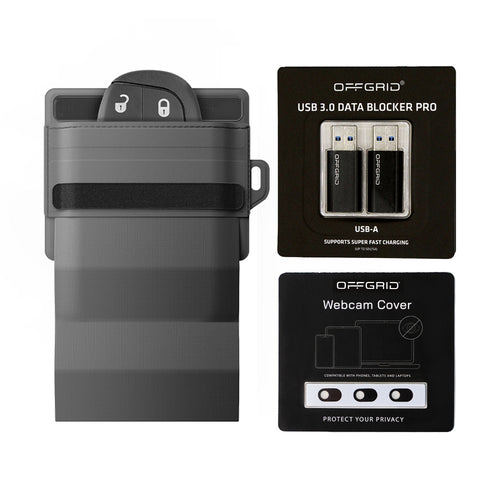

Your smartphone is rarely quiet.
Even when it’s sitting untouched on a desk, it may still be communicating through cellular networks, Wi-Fi, Bluetooth, GPS-related services, NFC, and other wireless systems. Modern phones are designed to stay connected whenever possible.
Put that same phone inside a properly designed shielded enclosure, and its relationship with the outside world changes almost immediately.
But what is actually happening inside?
First, the Phone Loses Its Connection
A shielded enclosure, such as a Faraday bag, is designed to reduce electromagnetic signals from passing between the device and the outside environment.
Once a smartphone is properly enclosed, cellular, Wi-Fi, Bluetooth, and other supported radio-frequency signals can be significantly attenuated or blocked, depending on the shielding performance of the enclosure and the frequencies involved.
The phone itself hasn’t been turned off.
It has simply been separated from the wireless networks around it.
That distinction matters.
The Phone May Start Looking for a Network
When cellular service disappears, the phone doesn’t necessarily give up immediately.
Its radio hardware may continue searching for an available network. Wi-Fi and Bluetooth services can also continue operating internally even though communication outside the enclosure has been disrupted.
In other words, shielding doesn’t tell the phone to stop communicating.
It prevents that communication from successfully reaching the outside world.
This is one reason a Faraday enclosure is fundamentally different from changing a software setting. Airplane mode depends on the phone and its operating system. Physical RF shielding creates a barrier around the device.
What Happens to Incoming Calls and Messages?
If the enclosure is effectively blocking the relevant cellular frequencies, the network can no longer establish its normal radio connection with the phone.
Calls may be routed to voicemail according to the carrier’s normal behavior. Messages and other network-dependent notifications generally cannot be delivered to the device until connectivity returns.
Once the phone is removed from the enclosure and reconnects, pending messages, emails, notifications, and other data may begin arriving.
The important point is that the enclosure does not delete or intercept this information. It temporarily isolates the phone from the wireless connection required to receive it.
What About GPS?
GPS works a little differently.
A smartphone typically receives signals from navigation satellites rather than transmitting directly to them. Those signals are extremely weak by the time they reach the surface of the Earth.
A shielded enclosure designed to attenuate the relevant frequencies can prevent the phone from receiving those satellite signals.
However, putting a phone inside a Faraday bag does not erase location information that already exists on the device.
Shielding is about controlling wireless communication, not deleting stored data.
Bluetooth Accessories Lose Their Link Too
Bluetooth is another connection people often forget about.
Smartwatches, earbuds, vehicle systems, trackers, keyboards, and other nearby accessories rely on short-range radio communication with your phone.
When the phone is properly shielded, those external Bluetooth connections should no longer be able to communicate normally through the enclosure.
The same principle applies: the phone may still have Bluetooth enabled, but the signal has to get through the shielding to reach another device.
The Phone Is Still Running
This is probably the biggest misconception about Faraday shielding.
A Faraday bag is not an off switch.
Apps can remain open. The operating system continues running. Files remain stored. Alarms may still function. Offline processes can continue.
What changes is the device's ability to communicate wirelessly through the shielded environment.
Think of it less like shutting down the phone and more like placing a physical boundary around its radios.
Why Closure Design Matters
The shielding material is only part of the equation.
A Faraday enclosure also needs an effective closure. Gaps, worn material, damaged seams, or an improperly closed opening can create opportunities for RF energy to pass through.
That is why professional shielding products are designed as complete systems rather than simply wrapping conductive fabric around a device.
At OffGrid, this principle applies across our shielding products, from compact Faraday phone bags to tablet and laptop sleeves and larger enclosures designed for multiple devices.
Different devices may require different sizes, but the basic goal remains the same: create a properly enclosed RF-shielded environment around the electronics inside.
Why Would You Want to Isolate a Phone?
There isn't one single reason.
Digital forensic investigators may need to isolate a seized device from external network communication. Travelers may want another physical layer of privacy for devices they aren't actively using. Organizations may need controlled storage for phones, tablets, key fobs, or other wireless electronics.
Some people simply want the ability to decide when a device can communicate.
That's where products such as the OffGrid Premium Faraday Bags fit naturally. Available for phones, tablets, and laptops, they provide a physical method of isolating devices without requiring you to trust that every wireless setting has been configured correctly.
For larger equipment or multiple devices, the same shielding principle can be applied through larger Faraday enclosures and bags.
Shielding Doesn't Make the Data Disappear
It's equally important to understand what a Faraday enclosure doesn't do.
It doesn't erase your browsing history.
It doesn't remove malware.
It doesn't delete location history already stored on the phone.
It doesn't stop offline software from running.
And it doesn't replace good digital security practices.
RF shielding addresses one specific part of privacy and security: wireless communication between the protected device and the outside environment.
That's what makes it useful.
Instead of trying to solve every privacy problem at once, it creates a physical layer between your device and the networks surrounding it.
What Happens When You Take the Phone Back Out?
The barrier disappears.
The phone can begin reconnecting to available cellular networks, Wi-Fi access points, Bluetooth devices, and satellite navigation signals according to its settings.
Notifications may suddenly appear. Messages may arrive. Apps may refresh.
From the phone's perspective, wireless connectivity has returned.
That simple transition demonstrates what Faraday shielding is really doing.
The phone never stopped being a smartphone.
For a while, it just couldn't talk to the outside world.
Go OffGrid When You Want the Signal to Stop
Privacy doesn't always require complicated software or another setting buried inside a menu.
Sometimes the simplest approach is physical.
When you need a device isolated, put a barrier between it and the signals around it.
OffGrid Faraday bags are built to provide that barrier for phones, tablets, laptops, and other wireless devices, giving you a physical layer of protection when staying connected isn't the goal.