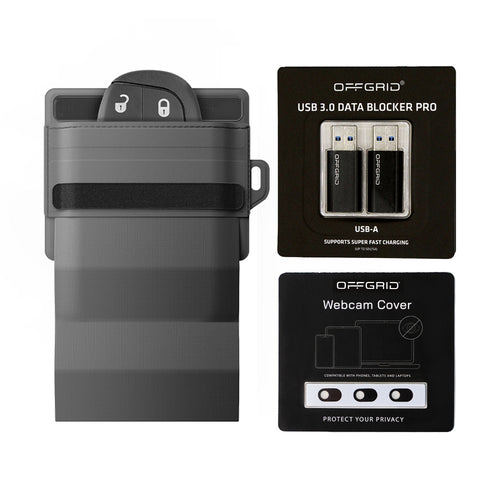

If you care about digital privacy, vehicle security, or protecting sensitive electronics, you’ve probably come across two terms: Faraday bags and signal jammers. They both relate to blocking wireless signals, but that’s where the similarities end. From how they work to whether they’re legal, the differences are significant.
In this guide, we’ll break down the legal and practical differences between Faraday bags and signal jammers, explain how each one works, and help you understand which option is safe and compliant to use.
What Is a Faraday Bag?
A Faraday bag is a signal-blocking pouch lined with conductive materials that shield devices from electromagnetic fields. When you place a phone, key fob, tablet, or other electronic device inside a properly designed Faraday bag, the bag blocks incoming and outgoing signals such as cellular, WiFi, Bluetooth, GPS, and RFID.
The science behind it is based on the Faraday cage principle. Conductive materials redistribute electromagnetic energy around the exterior surface, preventing signals from penetrating the interior. The result is total signal isolation without emitting anything into the surrounding environment.
Faraday bags are commonly used for digital privacy, vehicle key fob protection, data security, and travel security. Law enforcement and military professionals also use Faraday bags to preserve digital evidence by preventing remote wiping or tampering.
Most importantly, Faraday bags are legal to own and use in the United States and in most countries. They do not interfere with public networks or disrupt signals around you. They simply block signals to and from the device inside the bag.
What Is a Signal Jammer?
A signal jammer is a device that actively transmits radio frequencies to interfere with wireless communications. Instead of shielding one device, a signal jammer floods an area with noise on specific frequencies to prevent phones, GPS units, drones, or other wireless devices from connecting to networks.
Signal jammers are designed to disrupt signals across a certain range. For example, a cell phone jammer can block cellular service in a room or building. A GPS jammer can interfere with location tracking devices within its broadcast radius.
Unlike Faraday bags, signal jammers emit radio signals. That emission is what makes them illegal in the United States for civilian use. The Federal Communications Commission strictly prohibits the marketing, sale, or use of signal jammers because they interfere with licensed communications, including emergency services.
Using a signal jammer can result in substantial fines and even criminal penalties. The legal risk alone makes signal jammers a nonstarter for most people.
Key Legal Differences
The biggest difference between Faraday bags and signal jammers is legality.
Faraday bags are passive shielding devices. They do not transmit signals. They do not disrupt public networks. They only block signals from reaching the device placed inside them. Because of this, they are legal for everyday consumer use.
Signal jammers are active interference devices. They broadcast radio frequency signals to overpower legitimate communications. In the United States, the use of signal jammers is illegal for the general public under federal law. Even advertising or selling them can violate FCC regulations.
If your goal is privacy or security, choosing a legal signal blocking solution matters. A Faraday bag gives you signal isolation without breaking the law.
Practical Differences in Everyday Use
Beyond legality, Faraday bags and signal jammers serve very different purposes in real-world scenarios.
A Faraday bag is ideal when you want to isolate a specific device. For example, placing your key fob inside a Faraday pouch prevents relay attacks that thieves use to steal modern vehicles. Storing your smartphone in a Faraday bag protects against location tracking and remote access. Traveling with a Faraday bag can reduce the risk of RFID skimming and unwanted wireless connections.
Signal jammers, on the other hand, are designed to disrupt communications across a wider area. They are not precise. They affect everyone within range, not just your own device. That makes them impractical and unsafe in most civilian situations.
If you are trying to protect your own data, your own vehicle, or your own privacy, a Faraday bag gives you control without affecting anyone else.
Privacy, Security, and Compliance
People often search for ways to block cell phone tracking, prevent car theft, or protect against hacking. It’s important to choose solutions that are both effective and compliant with the law.
A high-quality Faraday bag blocks cell signals, GPS signals, WiFi, Bluetooth, and RFID by design. When properly sealed, it creates complete signal isolation. There is no partial interference, no broadcasting, and no disruption to nearby networks.
Signal jammers create chaos on shared frequencies. They can interfere with emergency calls, aviation systems, and public safety communications. That’s why regulators take them seriously.
If your goal is secure signal blocking for personal use, Faraday bags are the responsible and legal option.
Which One Should You Choose?
For personal privacy, vehicle security, digital evidence protection, and travel safety, a Faraday bag is the clear choice. It is legal, passive, portable, and easy to use. You simply place the device inside and seal the enclosure.
Signal jammers are illegal for civilian use in the United States and carry significant legal risks. They also create unintended consequences by disrupting communications for everyone nearby.
When comparing Faraday bags vs signal jammers, the difference comes down to passive shielding versus active interference, legal compliance versus legal risk, and personal protection versus public disruption.
If you want reliable signal blocking without crossing legal lines, a Faraday bag provides secure, compliant protection for your devices and your privacy.
Explore OffGrid’s Faraday bags to protect your phone, key fob, and sensitive electronics with trusted signal blocking technology designed for real-world security.